
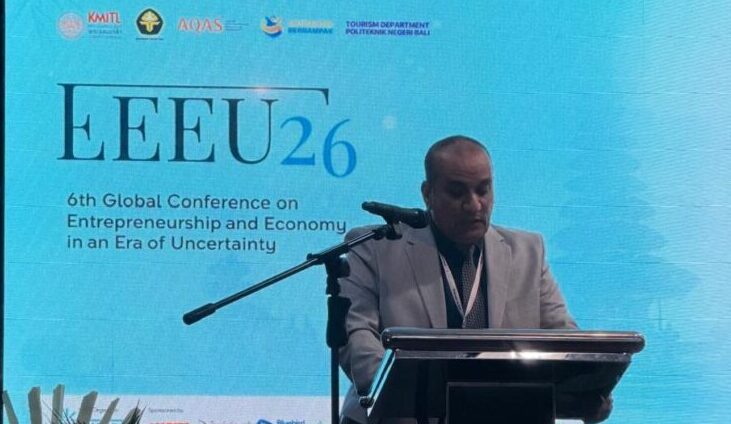
Prof. Dr. Aqeel Al-Hasnawi, President of the Akkad Center for Economic and Financial Studies, participated as a keynote speaker at the EEEU26 International Conference in Bali, Indonesia, presenting an academic insight on the digital transformation of the tourism sector and its impact on customer expectations, satisfaction, and purchasing behavior.
The President of the Akkad Center for Economic and Financial Studies, Prof. Dr. Aqeel Al-Hasnawi, participated in the work of the EEEU26 International Conference held in Bali, Indonesia, as a keynote speaker, where he delivered a speech on the rapid transformations witnessed by the tourism sector in light of the digital revolution, and its implications on customer experience and purchasing behavior.
The speech, titled “Customer Expectations, Satisfaction and Purchasing Behaviour in Transforming Digital Tourism Services”, focused on the growing role of digital technologies in reshaping the tourism industry, from inspiration, research and planning, through booking, payment and travel, to valuation and buyback.
Digital transformation is reshaping the tourism industry
During his speech, Prof. Dr. Aqeel Al-Hasnawi stressed that the tourist’s experience in the digital age no longer begins upon arrival at the airport, but begins early through digital screens and platforms, which have become an essential part of the various stages of the tourist journey.
The presentation addressed the scale of the transformation witnessed by the tourism sector globally, pointing out that about 1.5 billion arrivals of international tourists were recorded during 2024, with revenues of nearly US$1.7 trillion, an average trip spend of approximately US$1,170, and an increase in the number of international arrivals by 12% compared to 2023.
He explained that the tourism industry has moved from a traditional model based on travel offices, brochures and telephone calls, to a digital system based on electronic reservations, websites, applications and digital payments, to smart tourism that employs artificial intelligence, big data, the Internet of Things, personalization and predictive services.
The modern tourist… A digital customer with new expectations
The keynote address addressed the transformation of the contemporary tourist, who has become a digital customer with increasing expectations towards the quality of services and their tourism experience.
The presentation outlined a set of key expectations, including convenience, speed, personalization, transparency, security, flexibility, authenticity, and ease of handling, with a focus on five key pillars of customer digital value: convenience, personalization, speed, trust and security, and quality of experience.
Prof. Al-Hasnawi also addressed the relationship between personalization and customer behavior, noting that the presentation provided data that the probability of repurchase increases by 78% when customization is available.
Customer satisfaction as a pathway to loyalty and buybacks
The presentation focused on the relationship between digital service quality and customer satisfaction and loyalty, through a framework that links service quality, customer expectations, perceived performance, satisfaction, trust, and loyalty, all the way to a buyback or service recommendation.
Prof. Al-Hasnawi explained that customer satisfaction is not just an immediate response, but rather a cumulative judgment that is formed when the performance of a service meets or exceeds the customer’s expectations.
The presentation also addressed four levels of satisfaction: functional, digital, experiential and emotional. Job satisfaction is related to reliability and meeting basic needs, while digital satisfaction is related to ease of use, speed and technical quality, experiential satisfaction is related to the cohesion of the tourist trip and special moments, while emotional satisfaction is related to the customer’s feeling understood, cared for, and connected.
The presentation stressed that technological development alone is not enough to achieve an integrated tourism experience, unless it is coupled with a meaningful experiential and emotional value.
From Satisfaction to Buying Behavior
The speech also discussed the relationship between customer satisfaction and measurable behavioral outcomes, including purchase intent, actual purchase, repurchase, cross-selling, spending levels, recommendations, and positive reviews.
The presentation presented the customer journey as a continuous learning loop that starts with inspiration and research, then compares, books, pays, experiments, and reviews, and ends with a buyback. In this model, behavioral data helps develop personalization and improve the customer experience in their future journey.
The presentation also highlighted the growing influence of social media in travel decisions, noting that 92% of young travellers were influenced or inspired by social media on their recent trip, with platforms such as TikTok, Instagram, YouTube and Google Reviews emerging as influential sources of contemporary tourism decision-making.
Artificial Intelligence Draws New Features for Tourism
Prof. Hasnawi devoted an important part of his speech to discussing the transition from digital tourism to AI-powered tourism.
The presentation covered a range of applications, including travel assistants, chatbots, personalized recommendations, dynamic pricing, demand forecasting, sentiment analysis, predictive services, and generative trip planning.
In this context, the presentation raised the question of the relationship between AI and human service: does AI replace or enhance the human element?
The presentation focused on employing artificial intelligence in automating transactions and reducing friction in procedures, while preserving the human dimensions of the tourism experience.
The presentation also addressed the challenge of balancing personalization and privacy, as personalization requires access to more customer data, while protecting privacy requires limiting data exposure. The presentation therefore emphasized the importance of responsibility, security, transparency, consent, and ethical use of data in digital tourism.
Bali… A Live Lab for Digital Tourism
The keynote dedicated a special space to the island of Bali as a major international tourist destination, describing it as a “living laboratory for digital tourism“, in light of the significant growth of tourism in the country.
According to the data covered by the offer, Bali received 6,948,754 international visitors during 2025, an increase of 9.72% compared to 2024. The island also recorded about 697,110 direct international visits in July 2025, an annual increase of 11.42%, while the number of international visits during the period from January to July 2025 reached about 3.98 million visits.
In light of these data, Prof. Dr. Aqeel Al-Hasnawi posed a strategic question to tourism companies and destinations on how to turn each expatriate into a long-term customer, and link this to the concept of customer value for life.
This concept includes building a sustainable relationship between the tourist and the various components of the tourism ecosystem, from hotels, restaurants, transportation, and tours, to shopping, attractions, frequent visits, and recommendations.
An Integrated Framework for Understanding the Value of Digital Tourism
During his participation, Prof. Al-Hasnawi presented an integrated framework linking digital transformation, digital service quality, customer expectations, perceived experience, customer satisfaction, and purchasing behavior, while integrating artificial intelligence, personalization, social media, and digital trust into the modern tourism environment.
The framework linked these elements to a range of behavioral outcomes, including purchase intent, repurchase, spend, and recommendation, reflecting the transition from measuring satisfaction alone to understanding the actual customer’s behavior.
The presentation concluded with a set of administrative directions for tourism organizations, most notably:
- Streamline the customer journey and enhance convenience at all stages.
- Employing data in intelligent personalization without compromising customer privacy.
- Enhance digital trust through security, privacy, and transparency.
- Integrate AI with human service and automate procedures while maintaining the human aspect.
- Move from satisfaction measurement to behavior measurement, across indicators such as buyback, engagement, spend, and recommendations.
Towards customer-centric tourism
In conclusion, Prof. Dr. Aqeel Al-Hasnawi stressed that the future of tourism is not limited to digital transformation, but is moving towards a customer-centric model powered by digital intelligence.
The presentation emphasized that the combination of convenience, personalization and trust is a pivotal element in responding to customer expectations, along with providing seamless digital services and high-quality human experiences.
The participation of the President of the Aked Center for Economic and Financial Studies in the EEEU26 conference reflects an academic presence in the international debate on the future of tourism in light of digital transformation, by examining the relationship between technology, customer behavior, artificial intelligence, and the quality of tourism services, and focusing on the economic and administrative dimensions to transform positive digital experiences into sustainable customer relationships, repeat purchases, and continuous recommendations.