
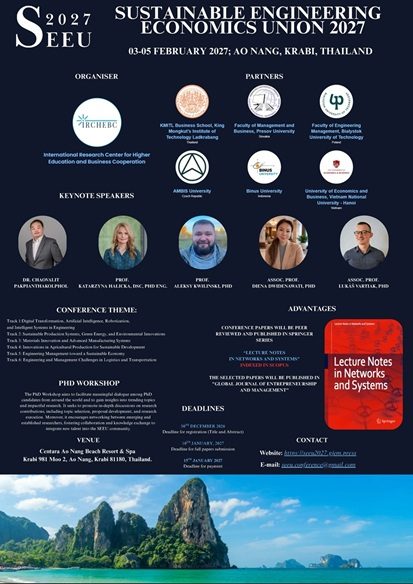
Within the framework of research cooperation with research institutions and international universities, the Akad Center for Economic and Financial Studies invites researchers to participate in the international conference tagged:
“Sustainable Engineering Practices for Economic Growth and Environmental Resilience”
The Union for Sustainable Engineering and Economics (SEEU) will hold its global conference from 3 to 5 February 2027, at the Centara Ao Nang Resort in Krabi, Thailand. The event will be hosted by the Business School of King Mongkut University of Technology in Ladkrabang (KMITL) and in collaboration with the University of Breşov in Slovakia. The conference will focus on core and long-term issues in the fields of sustainable engineering and economic practices, with the main theme being “Sustainable Industrial Engineering Practices: Supporting Economic Growth and Environmental Resilience”, as well as assessing the opportunities and risks associated with automation, artificial intelligence and innovation for sustainable development in light of global technological crises.

SEEU 2027 focuses on project-based learning, technical courses, and applied solutions that integrate engineering, economics, and long-term sustainability principles in a predominantly practical rather than purely theoretical manner. The conference covers the following research tracks:
- Track I: Digital Transformation, Artificial Intelligence, Robotic Automation, and Intelligent Systems in Engineering
From efficiency and automation to sustainable and flexible human-centered operating models, industrial production is constantly evolving. The integration of artificial intelligence, multi-agent networks, multimedia systems, digital twins, connected sensors, and collaborative industrial robotics is fundamentally changing manufacturing, core infrastructure, and process management. At the same time, the high electrical requirements of data centers and advanced computer systems pose serious long-term technological challenges. Other research goals include policy applications such as global AI governance standards, autonomous systems ethics, algorithmic justice, and market shifts resulting from cost-effective AI models. Smaller-scale practical constraints also deserve special attention, such as the adoption of technology in small businesses, worker retraining, the development of local digital ecosystems, the cybersecurity of supply chains, and ethical automation that must fit into regional legal systems. We encourage you to do so.
- Track Two: Sustainable Production Systems, Green Energy, and Environmental Innovations
Pressure is mounting on industrial sectors to maintain economic competitiveness, protect ecosystems, and reduce total carbon emissions; areas such as expanding circular economy frameworks, integrating renewable energy into existing energy systems, implementing energy storage systems, using clean hydrogen, carbon sequestration, and creating a manufacturing infrastructure that can withstand extreme weather conditions are important areas of study. We place a clear priority on assessing true financial viability, taking into account initial capital costs, availability of raw materials, investment risks, and international trade impacts. Elements of implementation at the local and regional levels are equally important, so proposals should include aspects such as factory modernization to reduce carbon emissions, community energy grids, transformation strategies in areas that have historically relied on fossil fuels, societal impacts, and industrial solutions tailored to emerging economies. In order to develop practical plans for transformation, we are looking for research that combines environmental technology with sound financial and policy analysis.
- Track Three: Material Innovation and Advanced Manufacturing Systems
Advanced materials such as self-healing composites, shape memory alloys, low-carbon composites, biomaterials, and energy storage media are a key pillar of industrial modernization and industrial process optimization, in parallel with modern production systems. Globally, issues are emerging related to reducing dependence on bio-based raw materials, designing products to be recyclable at the end of their lifespan, adopting “digital product passports”, and achieving environmental goals. At the facility and regional level, the focus is on the practical challenges facing small-scale manufacturers upon implementation, local material supply chains, regional material reuse networks, infrastructure maintenance, safety standards in structural engineering, and actual operational costs. We encourage the submission of interdisciplinary research papers that combine materials science, production engineering, lifecycle calculations, and cost management.
- Track Four: Innovations in Agricultural Production for Sustainable Development
Issues such as climate change, water scarcity, soil degradation, biodiversity loss, and growing demand for food are putting significant pressure on the global agriculture sector. Regenerative agricultural practices, precision agriculture, field sensors, agricultural robotics, farm emission reduction systems, closed-loop fertilizer management, alternative proteins, and climate-resilient crops remain a key goal. Aligning sustainable food production with environmental conservation remains a key goal. Priorities at the local level include designing equipment for small and medium-sized farms, developing regional food supply chains, managing irrigation in dry regions, combining traditional agricultural expertise with modern technologies, and promoting rural economic development. We look forward to receiving articles demonstrating how new tools and business models are increasing agricultural production while maintaining the sustainability of production under diverse economic conditions.
- Track Five: Engineering Management Towards a Sustainable Economy
Today’s corporate strategy involves directly managing engineering. Creating service-oriented circular business models, managing climate risks, building technical teams capable of using AI responsibly, integrating environmental and social indicators into design decisions, and guiding companies’ carbon reduction goals are among the important concerns. Project management, workforce mobility strategy, and advanced infrastructure management are also essential skills for contemporary operations. Employee retraining programs, team diversity, university alliances, barriers to technology adoption, and engineering education tailored to volatile markets are topics of interest within individual companies and regional industry associations. Empirical studies and field research show how contemporary management approaches improve economic stability and corporate resilience.
- Track VI: Engineering and Management Challenges in Logistics and Transportation
Global supply chains are undergoing fundamental transformations driven by the reshaping of trade alliances, nearshoring, decarbonization legislation, and autonomous transportation systems. These transformations include low-carbon shipping, recovery from supply chain disruptions, reverse logistics, improved transport routes using artificial intelligence, zero-emission transport fleets, and vehicle automation. These include charging station networks, the integration of autonomous fleets into civil traffic systems, digital network models, and business strategies under changing safety standards. Significant local challenges related to “last mile” connectivity, urban freight hubs, connecting regional transport networks, expanding national infrastructure, and enhancing local economic access are highlighted.
This conference is organized by the International Research Center for Higher Education and Business Cooperation in Poland
Publishing:
The papers presented for the conference will be evaluated and published in Lecture Notes in Networks and Systems within the Springer International Publishing House, which is indexed in the Scopus database.
https://www.scopus.com/sourceid/21100901469
Timings:
Deadline for Submission (Title and Abstract) 30/12/2026
Deadline for submitting full research 10/1/2027
Conference Date 3-5/2/2027
Expected Date of Publication 15/10/2027
The research submitted should be:
- Within the research tracks of the conference
- The research must be original and not published anywhere else
- Theft rate is less than 10%
- Artificial intelligence rate below 20%
- The research is presented in the research template of Springer International Publishing House in terms of research structure, guaranteed as well as the style of writing sources.
- Research provides a scientific addition in the field of specialization
For more details, please visit the conference website: