
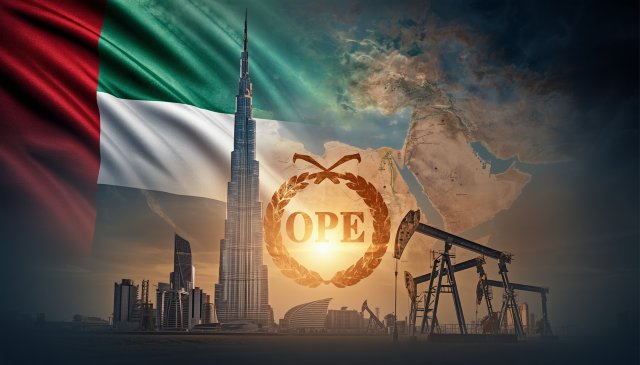
UAE withdraws from OPEC in major blow to oil producers’ alliance
It would seem that there is much more to the United Arab Emirates’ (U.A.E.) decision to withdraw from the Organization of the Petroleum Exporting Countries (O.P.E.C.) and OPEC+, beginning on May 1st, 2026 than an ordinary, short term economic headline. The U.A.E., one of OPEC’s largest producers, has long been part of a coordinated effort to stabilize crude oil prices through controlled production levels. However, the U.A.E. now finds itself in a position where its long-term vision for the energy industry can no longer be achieved under a rigidly defined organization.
According to the U.A.E.’s formal statement regarding its withdrawal, the decision stems from the need to develop its own “strategic, long-term vision” that is consistent with its energy development efforts. These include increasing investment in local production and adapting to changes in the global oil market. Therefore, the U.A.E. has shifted from being committed to a collective goal as part of an organization, to pursuing its own national interests, and allowing for greater flexibility when making decisions.
Behind this formal rationale exists a more complex narrative. For many years, OPEC+ has struggled with increasing difficulty in reaching agreement among its members concerning their individual interests. As a result, countries with significant scalable production capacity, like the U.A.E., have often found themselves restricted by production limits that fail to accurately reflect their potential output. One of the primary factors motivating the U.A.E.’s decision was to rectify this imbalance between what the U.A.E. could potentially produce and what actually was produced.
Additionally, consideration needs to be given to the broader geopolitical implications associated with the U.A.E.’s withdrawal. The global energy market has experienced considerable instability over recent years due to ongoing regional conflicts. Most notably, there have been tensions involving Iran that have resulted in disruptions to oil supplies, negatively impacting the global economy. Under these circumstances, the ability of producing countries to independently manage their own production is viewed as a strategic advantage. Conversely, reliance upon collective agreements that may not be sufficiently rapid or flexible in response to fluctuations in supply and demand could prove disadvantageous.
The U.A.E.’s withdrawal represents a serious setback for OPEC, both in terms of the volume of production lost, and the significance of its role within the organization. The U.A.E. possesses surplus production capacity, providing a critical component in OPEC’s ability to rapidly adjust production levels to maintain equilibrium in the global market. The loss of this capability will undoubtedly weaken OPEC’s ability to effectively impact global petroleum prices.
It appears likely that the withdrawal of the U.A.E. from OPEC will contribute to a decline in OPEC’s overall influence in controlling the global oil market. OPEC has traditionally relied upon cooperation among a small group of large producers to achieve its goals. An increase in the influence of one larger player may reduce the ability of OPEC to collectively control the market; thereby creating a higher degree of competition among producing nations.
Initial investor responses have ranged from concern and apprehension toward anticipating possible positive outcomes resulting from the U.A.E.’s departure from OPEC. Specifically, investors recognize that an unregulated increase in global oil production outside of the OPEC framework may lead to excess supply and downward pressure on oil prices.
However, it is unlikely that the U.A.E. will implement an unfettered expansionist production policy. Rather, according to the U.A.E.’s public comments, the country intends to pursue responsible increases in production consistent with supply/demand imbalances. The U.A.E.’s stated intention reflects an attempt to create a balance between maximizing its own independence and maintaining price stability – an extremely difficult task that will serve as an early gauge of the success of the U.A.E.’s post-OPEC oil policy initiatives.
Furthermore, the U.A.E.’s decision creates a major problem for other OPEC member countries. Notably, Saudi Arabia, which serves as the de facto leader of OPEC, will be required to reassess its organizational strategy; either through strengthened cooperation with remaining member countries or through forming new partnerships designed to replace the lost U.A.E. contribution to OPEC. Similarly, countries such as Iraq and Kuwait will experience indirect consequences stemming from this eventuality; specifically, reduced prices and/or increased price volatility.
Historically speaking, OPEC has faced comparable crises; however, each time it has adapted and persevered. Presently, however, the global oil market is far more diverse than it once was; therefore, should divisions arise among OPEC member countries leading to weakened coordination within the organization, any negative impacts felt from those divisions could be amplified compared to previous events.
Therefore, it ultimately lies with how successfully OPEC and its member countries address this challenge that determines whether OPEC continues to wield significant influence or declines in influence. Additionally, this decision may provide incentive for other countries to consider their own membership status within OPEC; particularly if they believe that acting independently provides them with greater advantages. This outcome could conceivably lead to a fundamental shift in how the global oil market functions; namely from a system based upon geographic blocks toward an increasingly competitive and individually driven marketplace.
Ultimately, the U.A.E.’s decision to withdraw from OPEC is not merely an economic event; rather it serves as a harbinger signaling entry into a new era in global energy history; one characterized by greater autonomy, diminished collective coordination and increased uncertainty. Although the U.A.E. may derive benefits from this action, such action is destined to have ramifications extending far beyond the boundaries of this single nation onto oil markets and economies worldwide.
Therefore, this decision is currently subject to multiple interpretations; none of which will begin to fully emerge until after additional months and years pass; during which time all interested parties will closely monitor developments.