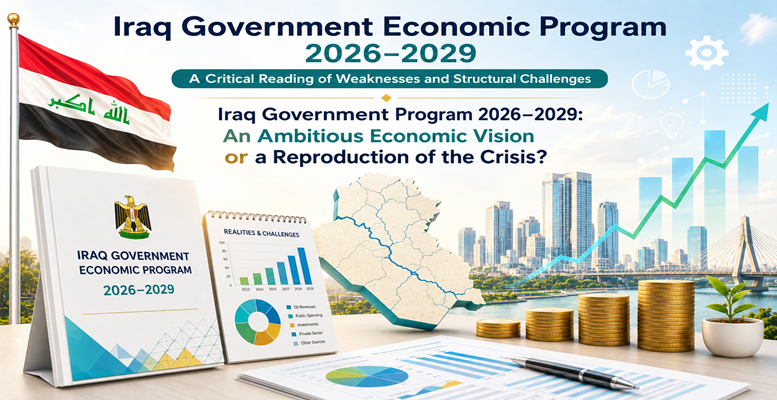
Despite the reform-oriented language that characterized the Iraqi Government’s Economic Program for 2026–2029, and despite its promises to rebuild the national economy on the foundations of “production, diversification, and sustainability,” a deeper economic analysis reveals that the program remains constrained by a set of structural problems that have accompanied the Iraqi state since 2003. Indeed, some of these problems are indirectly reflected within the text itself. Although the program attempts to present a vision of a state more capable of managing the economy, it has not fully escaped the nature of a rentier economy, nor the political and institutional constraints that limit the implementation of any profound economic reform.
One of the program’s most fundamental weaknesses lies in the rhetorical and declaratory nature of many of its economic provisions. The document employs terms such as “economic diversification,” “productive economy,” “financial sustainability,” and “private sector empowerment,” yet these concepts are not translated into clear implementation plans with measurable quantitative targets. Governments are not evaluated by the eloquence of their slogans, but by performance indicators through which they can be monitored and held accountable. The program, for example, does not specify a target percentage for reducing dependence on oil, the expected growth rate of non-oil sectors, the unemployment rates it seeks to reduce, or even a clear timeline for achieving these transformations. Consequently, the economic vision remains closer to a broad political declaration than to a detailed economic program whose success or failure can be objectively assessed.
A deeper problem also emerges: while the program speaks of transitioning to a “productive economy,” it continues in practice to rely on the same rentier mechanisms that have entrenched the fragility of the Iraqi economy for decades. Oil revenues remain the primary source of financing for the state budget, for the reform projects themselves, and for maintaining social and political stability through salaries and government subsidies. This means that any sharp decline in oil prices could disrupt most of the programs outlined in the document, since the state has yet to build a genuine productive base capable of financing the economy independently of oil. Here lies the central paradox: the program declares its intention to move beyond the rentier economy while simultaneously remaining almost entirely dependent upon it.
Furthermore, the program does not go far enough in addressing the structural dysfunction of the public sector, which represents one of the greatest obstacles to economic development in Iraq. The Iraqi economy suffers from enormous administrative and employment inflation, as the state has become the primary employer for millions of citizens—not out of productive necessity, but as a result of political and social pressures. Nevertheless, the program clearly avoids discussing the restructuring of public employment, the problem of disguised unemployment, or the reform of the wage and subsidy system. It appears that the government has chosen to avoid this issue because of its high political cost, yet ignoring it effectively means the continued depletion of public finances and the persistence of weak productivity within state institutions.
Another major weakness is that the program places significant reliance on the private sector and foreign investment as engines of economic growth, while failing to provide a fundamental solution to the obstacles hindering private sector development in Iraq. The Iraqi economy suffers not only from a shortage of investment, but from an institutional environment that is fundamentally hostile to investment. Complex bureaucracy, administrative corruption, weak commercial judiciary institutions, overlapping regulatory authorities, and unstable legislation all make Iraq’s business environment one of the most fragile in the region. Although the program refers to the “one-stop shop” concept and improving the business environment, it does not offer a clear vision for dismantling this complex structure of obstacles facing both domestic and foreign investors. As a result, the discussion of attracting investment may remain largely ineffective unless accompanied by deep and genuine institutional reform.
On the fiscal side, shortcomings are evident in the absence of a precise vision for tax reform. The program refers to enhancing non-oil revenues and digitizing tax collection, yet it does not seriously address the crisis of Iraq’s tax system, which suffers from a narrow tax base, a vast informal economy, and high levels of tax evasion. Nor does it discuss restructuring the tax system in a way that promotes both equity and economic efficiency. Consequently, the issue of non-oil revenues remains a general slogan without genuine implementation tools, despite representing a cornerstone of any economic transformation away from oil dependency.
In the industrial sector, despite the program’s emphasis on supporting national industries and developing industrial cities, the industrial vision itself remains vague and poorly defined. No priority industrial sectors are identified, nor are mechanisms for industrial financing, export strategies, or protective policies that could balance the protection of domestic products with trade openness. This reflects the continued absence of an integrated national industrial policy—a problem that has accompanied the Iraqi economy for decades, as the industrial sector has remained weak and unable to compete due to the dominance of oil and imports.
In the agricultural sector, although the program discusses food security, modern irrigation systems, and encouraging agricultural investment, it fails to provide a strategic solution to the water crisis, which represents the greatest threat to the future of Iraqi agriculture. Iraq faces escalating water challenges due to upstream countries’ water policies and climate change, and this issue should have occupied a far more prominent and detailed place within the economic program. Instead, the discussion remains general and does not evolve into a comprehensive national strategy for water and food security.
It is also noteworthy that the program extensively discusses the establishment of new councils and institutions, such as the Supreme Council for Financial and Monetary Stability, the Supreme Investment Council, and the Generations Fund. Although institutional coordination is important, the Iraqi experience has demonstrated that the proliferation of institutions does not necessarily improve performance; in some cases, it may instead lead to overlapping mandates and expanded bureaucracy. It would have been more effective to focus on reforming existing institutions and enhancing their efficiency rather than expanding the creation of new structures that may face the very same problems.
Regarding anti-corruption efforts, the program appears less bold than the Iraqi crisis requires. It speaks of governance, digitization, and strengthening oversight institutions, yet it does not directly confront the political and economic structures that generate and protect corruption. Corruption in Iraq is no longer merely an administrative defect; it has become part of a complex network of interests in which politics, economics, and power are deeply intertwined. Therefore, any discussion of economic reform without genuine political and institutional reform will remain limited in its impact.
The program also fails to provide a clear vision for managing the major economic risks that Iraq may face in the coming years, such as oil price volatility, geopolitical crises, climate change, and global financial crises. The Iraqi economy is highly vulnerable to external shocks, and it was therefore essential for the program to include alternative scenarios and economic and financial contingency plans. However, it merely offers general references to “risk management” without substantive detail.
In conclusion, it can be argued that the government’s economic program demonstrates a relatively advanced awareness of the nature of Iraq’s economic crisis and reflects recognition of the country’s need for diversification, reform, digital transformation, and private sector empowerment. Nevertheless, this awareness has not yet evolved into a fully developed implementation framework. The core problem lies not in diagnosing the crisis, but in the absence of the political and institutional tools capable of addressing it. Accordingly, the greatest challenge facing the program is not the formulation of objectives, but rather the ability to implement them within a political, administrative, and economic environment that continues to suffer from deep structural imbalances.